Full seats at badge-in
ShiftGuard tells WFM tonight who will be missing tomorrow morning - so the shift is covered before it starts.


Staff transport for 24/7 operations
tripi runs staff transport like a control room. Autonomous routing plans every shift, Seat Assurance predicts who will badge in, live safety intelligence protects the night - and dispatch, billing and apps close the loop, in Rand, under POPIA.
ShiftGuard tells WFM tonight who will be missing tomorrow morning - so the shift is covered before it starts.
Guardian sequences every night route around lone passengers, precinct risk and load-shedding.
Waybills that match invoices, penalties that apply themselves, vendor scorecards that mean something.
StaySignal links commute burden to attrition risk - a workforce decision, not a cost centre.
Platform
Real screens from the platform. Move through the consoles a shift lead, a controller and a finance manager live in.


Seat Assurance
For every passenger on tomorrow's inbound trips, a Seat Confidence: historical reliability multiplied by the probability the vehicle delivers on time - rolled up per trip and per site into a shortfall list WFM can act on.
Live Trip Monitor
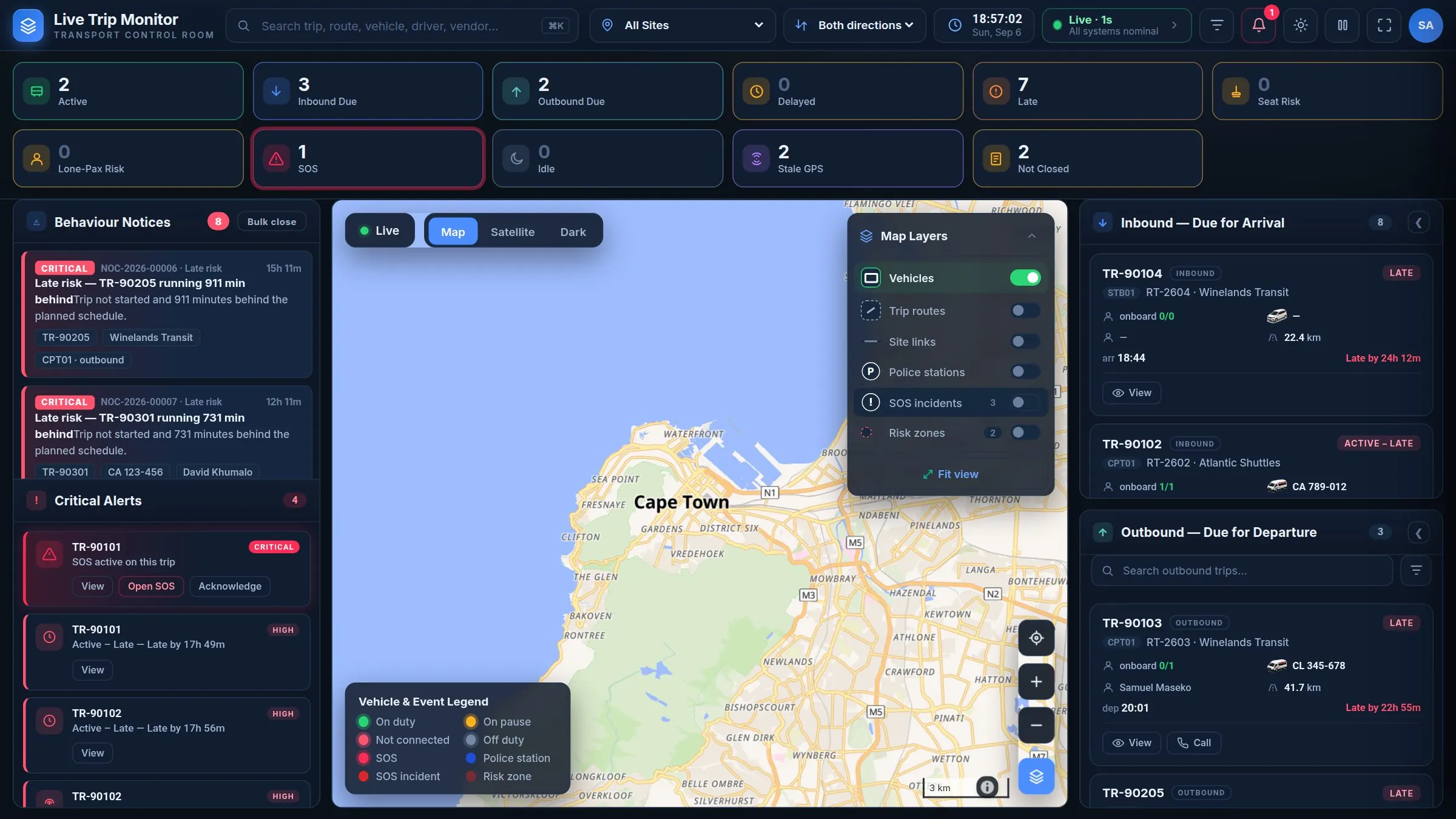
Every vehicle, every SOS, every police station and risk zone on one live map - with behaviour notices, stale-GPS alerts and one-tap call, relief and divert actions.
No-Show & Dynamic Rerouting
Cut-off detection marks the no-show, the fine enters a governed review queue, and the route is re-optimised with minimal disruption. Anything that breaks a constraint waits for a controller - nothing changes on a vehicle silently.
Capabilities
Booking to billing, request to badge-in - every module shares one data model, one audit trail and one control room.
Cluster demand by site, slot and service line; OSRM-optimised routes with live geography.
Schedules that plan every shift on time, emergency runs on demand, complete run history.
Reliability x delivery per passenger - who will be in their seat at badge-in.
Lone-passenger risk minimisation with precinct data, darkness and last-drop rules.
ETA and arrival-risk scoring with a graded intervention ladder for night routes.
A control room: vehicles, SOS, risk zones and behaviour notices on one map.
Cut-off detection, governed fines and minimal-disruption re-optimisation.
Vendor acceptance SLAs and compliance-gated vehicle and driver allocation.
Maker-checker approvals with SLA ordering, escalation and a decision register.
Waybill-to-invoice validation, PEPM pricing, penalties and vendor scorecards.
Executive and airport transfers with live flight status; timetabled shuttles.
Installable PWAs: booking, tracking, boarding codes, SOS, offline trip sheets.
Intelligence
Each engine is append-only and versioned: a model can be improved without a redeploy, and every score keeps its provenance.
A probability, per passenger, of being in the seat at shift start - rolled up into headcount projections WFM can act on the night before.
Sequences night drops so nobody is left alone in the dark, using precinct data, sunset and last-drop rules the NOC can override with a reason.
Blends ETA drift, night hours and grid status into risk bands that trigger a graded intervention ladder.
A Burden Score per employee that links commute experience to retention risk.
Every home address versioned, geocoded, approved and audited - pinned pickups, not guesses.
Passenger & driver apps
Installable progressive web apps - no app-store friction. Passengers book by service, track their vehicle, carry a boarding code and press SOS. Drivers get trip sheets that work offline, geofenced boarding and route updates they must acknowledge.
Service offerings
Each line is a first-class console with its own booking flow, eligibility and passenger-app experience - enabled per tenant with one switch.
Shift-linked home-to-work transport with eligibility rules, cut-offs, approvals, routing and dispatch.
Executive, client and airport transfers with vehicle class, live flight status, meet & greet and confidential handling.
Fixed inter-site routes with timetabled departures, seat capacity, waitlists and boarding-code check-in.
Safety & compliance
SOS from any app goes straight to the control room with location and identity. Risk zones, police stations and geofences live on the same map as your vehicles. Every address change, approval, reroute and fine is append-only and audited.
How it works
Five stages, one closed loop. Settlement feeds planning: reliability, cost and safety history shape tomorrow's routes.
Rosters and self-service create demand, validated against eligibility and cut-offs.
Autonomous routing clusters demand into optimised, safety-sequenced plans.
Vendors accept within SLA; compliant vehicles and drivers are allocated.
The control room watches every trip, intervenes early and handles SOS.
Waybills reconcile to invoices; penalties and scorecards close the loop.
Engagement
Start where you are. Grow into the model that fits your risk appetite.
Your transport team runs the operation on tripi - routing, dispatch, control room, billing and apps.
We run the control room and vendor governance for you, on the platform, to agreed SLAs.
Transport-as-a-service: capacity, safety cover and outcomes contracted end to end, priced per employee per month.
Questions
What operations, WFM and finance leaders ask first.
Still have questions?
Talk to us at hello@tripi.work or book a live walkthrough.
Yes. tripi governs vendors rather than replacing them: acceptance SLAs, compliance gates on vehicles and drivers, waybill-to-invoice validation and scorecards. Vendors work in a dedicated portal.
Purpose-bound collection, tenant isolation, versioned addresses with approval, vulnerability attributes never shown to vendors or drivers, and an append-only audit trail on every operational record - designed for POPIA from the first line.
Employees, shifts and eligibility can be integrated by API, scheduled import or validated upload, with source-of-truth rules per field. Payroll deduction and finance exports are batch-tracked with reversals.
The driver app is offline-first: trip sheets, boarding and status changes queue locally and sync when connectivity returns. The control room sees a stale-GPS alert the moment a vehicle goes quiet.
Sites, slots, employees and vendors are typically live within weeks, with autonomous routing switched on once address governance has been run. Managed and TaaS Assured include control-room set-up.
Request a demo
Bring your sites, shift patterns and fleet. We build your scenario on the platform and walk you through routing, safety, dispatch and billing - live, in under an hour.
Prefer e-mail? hello@tripi.work

